Difference between revisions of "009C Sample Midterm 1, Problem 5"
Jump to navigation
Jump to search
Kayla Murray (talk | contribs) |
Kayla Murray (talk | contribs) |
||
| Line 1: | Line 1: | ||
<span class="exam"> Find the radius of convergence and interval of convergence of the series. | <span class="exam"> Find the radius of convergence and interval of convergence of the series. | ||
| − | <span class="exam">(a) <math>\sum_{n=0}^\infty \sqrt{n}x^n</math> | + | <span class="exam">(a) <math>\sum_{n=0}^\infty \sqrt{n}x^n</math> |
| − | <span class="exam">(b) <math>\sum_{n=0}^\infty (-1)^n \frac{(x-3)^n}{2n+1}</math> | + | <span class="exam">(b) <math>\sum_{n=0}^\infty (-1)^n \frac{(x-3)^n}{2n+1}</math> |
{| class="mw-collapsible mw-collapsed" style = "text-align:left;" | {| class="mw-collapsible mw-collapsed" style = "text-align:left;" | ||
| Line 10: | Line 10: | ||
|'''Ratio Test''' | |'''Ratio Test''' | ||
|- | |- | ||
| − | | Let <math style="vertical-align: -7px">\sum a_n</math> be a series and <math>L=\lim_{n\rightarrow \infty}\bigg|\frac{a_{n+1}}{a_n}\bigg|.</math> | + | | Let <math style="vertical-align: -7px">\sum a_n</math> be a series and <math>L=\lim_{n\rightarrow \infty}\bigg|\frac{a_{n+1}}{a_n}\bigg|.</math> |
|- | |- | ||
| Then, | | Then, | ||
|- | |- | ||
| | | | ||
| − | If <math style="vertical-align: -4px">L<1,</math> the series is absolutely convergent. | + | If <math style="vertical-align: -4px">L<1,</math> the series is absolutely convergent. |
|- | |- | ||
| | | | ||
| − | If <math style="vertical-align: -4px">L>1,</math> the series is divergent. | + | If <math style="vertical-align: -4px">L>1,</math> the series is divergent. |
|- | |- | ||
| | | | ||
| − | If <math style="vertical-align: -4px">L=1,</math> the test is inconclusive. | + | If <math style="vertical-align: -4px">L=1,</math> the test is inconclusive. |
|} | |} | ||
| Line 55: | Line 55: | ||
!Step 2: | !Step 2: | ||
|- | |- | ||
| − | |The Ratio Test tells us this series is absolutely convergent if <math style="vertical-align: -5px">|x|<1.</math> | + | |The Ratio Test tells us this series is absolutely convergent if <math style="vertical-align: -5px">|x|<1.</math> |
|- | |- | ||
| − | |Hence, the Radius of Convergence of this series is <math style="vertical-align: -2px">R=1.</math> | + | |Hence, the Radius of Convergence of this series is <math style="vertical-align: -2px">R=1.</math> |
|} | |} | ||
| Line 65: | Line 65: | ||
|Now, we need to determine the interval of convergence. | |Now, we need to determine the interval of convergence. | ||
|- | |- | ||
| − | |First, note that <math style="vertical-align: -5px">|x|<1</math> corresponds to the interval <math style="vertical-align: -4px">(-1,1).</math> | + | |First, note that <math style="vertical-align: -5px">|x|<1</math> corresponds to the interval <math style="vertical-align: -4px">(-1,1).</math> |
|- | |- | ||
|To obtain the interval of convergence, we need to test the endpoints of this interval | |To obtain the interval of convergence, we need to test the endpoints of this interval | ||
|- | |- | ||
| − | |for convergence since the Ratio Test is inconclusive when <math style="vertical-align: -2px">L=1.</math> | + | |for convergence since the Ratio Test is inconclusive when <math style="vertical-align: -2px">L=1.</math> |
|} | |} | ||
| Line 75: | Line 75: | ||
!Step 4: | !Step 4: | ||
|- | |- | ||
| − | |First, let <math style="vertical-align: -1px">x=1.</math> | + | |First, let <math style="vertical-align: -1px">x=1.</math> |
|- | |- | ||
| − | |Then, the series becomes <math>\sum_{n=0}^\infty \sqrt{n}.</math> | + | |Then, the series becomes <math>\sum_{n=0}^\infty \sqrt{n}.</math> |
|- | |- | ||
|We note that | |We note that | ||
| Line 83: | Line 83: | ||
| <math>\lim_{n\rightarrow \infty} \sqrt{n}=\infty.</math> | | <math>\lim_{n\rightarrow \infty} \sqrt{n}=\infty.</math> | ||
|- | |- | ||
| − | |Therefore, the series diverges by the <math style="vertical-align: 0px">n</math>th term test. | + | |Therefore, the series diverges by the <math style="vertical-align: 0px">n</math>th term test. |
|- | |- | ||
| − | |Hence, we do not include <math style="vertical-align: -1px">x=1</math> in the interval. | + | |Hence, we do not include <math style="vertical-align: -1px">x=1</math> in the interval. |
|} | |} | ||
| Line 91: | Line 91: | ||
!Step 5: | !Step 5: | ||
|- | |- | ||
| − | |Now, let <math style="vertical-align: -1px">x=-1.</math> | + | |Now, let <math style="vertical-align: -1px">x=-1.</math> |
|- | |- | ||
| − | |Then, the series becomes <math>\sum_{n=0}^\infty (-1)^n \sqrt{n}.</math> | + | |Then, the series becomes <math>\sum_{n=0}^\infty (-1)^n \sqrt{n}.</math> |
|- | |- | ||
| − | |Since <math>\lim_{n\rightarrow \infty} \sqrt{n}=\infty,</math> | + | |Since <math>\lim_{n\rightarrow \infty} \sqrt{n}=\infty,</math> |
|- | |- | ||
|we have | |we have | ||
| Line 101: | Line 101: | ||
| <math>\lim_{n\rightarrow \infty} (-1)^n\sqrt{n}=\text{DNE}.</math> | | <math>\lim_{n\rightarrow \infty} (-1)^n\sqrt{n}=\text{DNE}.</math> | ||
|- | |- | ||
| − | |Therefore, the series diverges by the <math style="vertical-align: 0px">n</math>th term test. | + | |Therefore, the series diverges by the <math style="vertical-align: 0px">n</math>th term test. |
|- | |- | ||
| − | |Hence, we do not include <math style="vertical-align: -1px">x=-1 </math> in the interval. | + | |Hence, we do not include <math style="vertical-align: -1px">x=-1 </math> in the interval. |
|} | |} | ||
| Line 109: | Line 109: | ||
!Step 6: | !Step 6: | ||
|- | |- | ||
| − | |The interval of convergence is <math style="vertical-align: -4px">(-1,1).</math> | + | |The interval of convergence is <math style="vertical-align: -4px">(-1,1).</math> |
|} | |} | ||
| Line 137: | Line 137: | ||
!Step 2: | !Step 2: | ||
|- | |- | ||
| − | |The Ratio Test tells us this series is absolutely convergent if <math style="vertical-align: -5px">|x-3|<1.</math> | + | |The Ratio Test tells us this series is absolutely convergent if <math style="vertical-align: -5px">|x-3|<1.</math> |
|- | |- | ||
| − | |Hence, the Radius of Convergence of this series is <math style="vertical-align: -2px">R=1.</math> | + | |Hence, the Radius of Convergence of this series is <math style="vertical-align: -2px">R=1.</math> |
|} | |} | ||
| Line 147: | Line 147: | ||
|Now, we need to determine the interval of convergence. | |Now, we need to determine the interval of convergence. | ||
|- | |- | ||
| − | |First, note that <math style="vertical-align: -5px">|x-3|<1</math> corresponds to the interval <math style="vertical-align: -4px">(2,4).</math> | + | |First, note that <math style="vertical-align: -5px">|x-3|<1</math> corresponds to the interval <math style="vertical-align: -4px">(2,4).</math> |
|- | |- | ||
|To obtain the interval of convergence, we need to test the endpoints of this interval | |To obtain the interval of convergence, we need to test the endpoints of this interval | ||
|- | |- | ||
| − | |for convergence since the Ratio Test is inconclusive when <math style="vertical-align: -2px">R=1.</math> | + | |for convergence since the Ratio Test is inconclusive when <math style="vertical-align: -2px">R=1.</math> |
|} | |} | ||
| Line 157: | Line 157: | ||
!Step 4: | !Step 4: | ||
|- | |- | ||
| − | |First, let <math style="vertical-align: -1px">x=4.</math> | + | |First, let <math style="vertical-align: -1px">x=4.</math> |
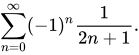
|- | |- | ||
| − | |Then, the series becomes <math>\sum_{n=0}^\infty (-1)^n \frac{1}{2n+1}.</math> | + | |Then, the series becomes <math>\sum_{n=0}^\infty (-1)^n \frac{1}{2n+1}.</math> |
|- | |- | ||
|This is an alternating series. | |This is an alternating series. | ||
|- | |- | ||
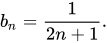
| − | |Let <math style="vertical-align: -16px">b_n=\frac{1}{2n+1}.</math>. | + | |Let <math style="vertical-align: -16px">b_n=\frac{1}{2n+1}.</math>. |
|- | |- | ||
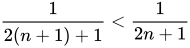
| − | |The sequence <math>\{b_n\}</math> is decreasing since | + | |The sequence <math>\{b_n\}</math> is decreasing since |
|- | |- | ||
| <math>\frac{1}{2(n+1)+1}<\frac{1}{2n+1}</math> | | <math>\frac{1}{2(n+1)+1}<\frac{1}{2n+1}</math> | ||
|- | |- | ||
| − | |for all <math style="vertical-align: -3px">n\ge 1.</math> | + | |for all <math style="vertical-align: -3px">n\ge 1.</math> |
|- | |- | ||
|Also, | |Also, | ||
| Line 177: | Line 177: | ||
|Therefore, this series converges by the Alternating Series Test | |Therefore, this series converges by the Alternating Series Test | ||
|- | |- | ||
| − | |and we include <math style="vertical-align: -1px">x=4</math> in our interval. | + | |and we include <math style="vertical-align: -1px">x=4</math> in our interval. |
|} | |} | ||
| Line 183: | Line 183: | ||
!Step 5: | !Step 5: | ||
|- | |- | ||
| − | |Now, let <math style="vertical-align: -1px">x=2.</math> | + | |Now, let <math style="vertical-align: -1px">x=2.</math> |
|- | |- | ||
| − | |Then, the series becomes <math>\sum_{n=0}^\infty \frac{1}{2n+1}.</math> | + | |Then, the series becomes <math>\sum_{n=0}^\infty \frac{1}{2n+1}.</math> |
|- | |- | ||
| − | |First, we note that <math>\frac{1}{2n+1}>0</math> for all <math style="vertical-align: -3px">n\ge 0.</math> | + | |First, we note that <math>\frac{1}{2n+1}>0</math> for all <math style="vertical-align: -3px">n\ge 0.</math> |
|- | |- | ||
|Thus, we can use the Limit Comparison Test. | |Thus, we can use the Limit Comparison Test. | ||
|- | |- | ||
| − | |We compare this series with the series <math>\sum_{n=1}^\infty \frac{1}{n},</math> | + | |We compare this series with the series <math>\sum_{n=1}^\infty \frac{1}{n},</math> |
|- | |- | ||
|which is the harmonic series and divergent. | |which is the harmonic series and divergent. | ||
| Line 206: | Line 206: | ||
|Since this limit is a finite number greater than zero, we have | |Since this limit is a finite number greater than zero, we have | ||
|- | |- | ||
| − | |<math>\sum_{n=0}^\infty \frac{1}{2n+1}</math> diverges by the | + | |<math>\sum_{n=0}^\infty \frac{1}{2n+1}</math> diverges by the |
|- | |- | ||
| − | |Limit Comparison Test. Therefore, we do not include <math style="vertical-align: -1px">x=2</math> | + | |Limit Comparison Test. Therefore, we do not include <math style="vertical-align: -1px">x=2</math> |
|- | |- | ||
|in our interval. | |in our interval. | ||
| Line 216: | Line 216: | ||
!Step 6: | !Step 6: | ||
|- | |- | ||
| − | |The interval of convergence is <math style="vertical-align: -4px">(2,4].</math> | + | |The interval of convergence is <math style="vertical-align: -4px">(2,4].</math> |
|} | |} | ||
| Line 223: | Line 223: | ||
!Final Answer: | !Final Answer: | ||
|- | |- | ||
| − | | '''(a)''' The radius of convergence is <math style="vertical-align: -2px">R=1</math> and the interval of convergence is <math style="vertical-align: -4px">(-1,1).</math> | + | | '''(a)''' The radius of convergence is <math style="vertical-align: -2px">R=1</math> and the interval of convergence is <math style="vertical-align: -4px">(-1,1).</math> |
|- | |- | ||
| − | | '''(b)''' The radius of convergence is <math style="vertical-align: -2px">R=1</math> and the interval | + | | '''(b)''' The radius of convergence is <math style="vertical-align: -2px">R=1</math> and the interval of convergence is <math style="vertical-align: -4px">(2,4].</math> |
|} | |} | ||
[[009C_Sample_Midterm_1|'''<u>Return to Sample Exam</u>''']] | [[009C_Sample_Midterm_1|'''<u>Return to Sample Exam</u>''']] | ||
Revision as of 17:59, 26 February 2017
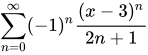
Find the radius of convergence and interval of convergence of the series.
(a)

(b)
| Foundations: |
|---|
| Ratio Test |
| Let be a series and |
| Then, |
|
If the series is absolutely convergent. |
|
If the series is divergent. |
|
If the test is inconclusive. |


Solution:
(a)
| Step 1: |
|---|
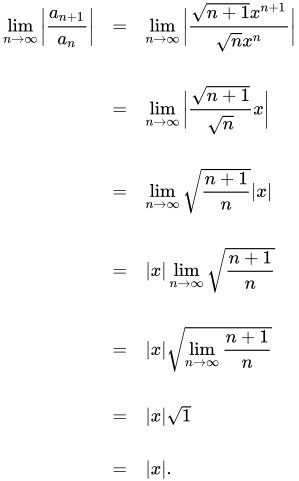
| We first use the Ratio Test to determine the radius of convergence. |
| We have |
| Step 2: |
|---|
| The Ratio Test tells us this series is absolutely convergent if |
| Hence, the Radius of Convergence of this series is |


| Step 3: |
|---|
| Now, we need to determine the interval of convergence. |
| First, note that corresponds to the interval |
| To obtain the interval of convergence, we need to test the endpoints of this interval |
| for convergence since the Ratio Test is inconclusive when |


| Step 4: |
|---|
| First, let |
| Then, the series becomes |
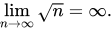
| We note that |
| Therefore, the series diverges by the th term test. |
| Hence, we do not include in the interval. |




| Step 5: |
|---|
| Now, let |
| Then, the series becomes |
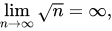
| Since |
| we have |
| Therefore, the series diverges by the th term test. |
| Hence, we do not include in the interval. |




| Step 6: |
|---|
| The interval of convergence is |
(b)
| Step 1: |
|---|
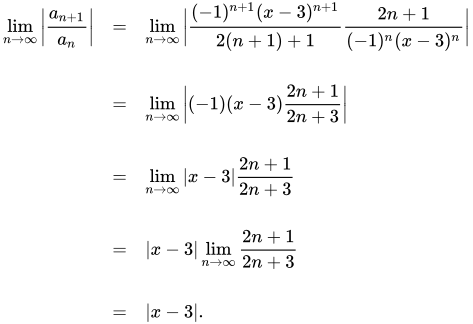
| We first use the Ratio Test to determine the radius of convergence. |
| We have |
|
|
| Step 2: |
|---|
| The Ratio Test tells us this series is absolutely convergent if |
| Hence, the Radius of Convergence of this series is |

| Step 3: |
|---|
| Now, we need to determine the interval of convergence. |
| First, note that corresponds to the interval |
| To obtain the interval of convergence, we need to test the endpoints of this interval |
| for convergence since the Ratio Test is inconclusive when |


| Step 4: |
|---|
| First, let |
| Then, the series becomes |
| This is an alternating series. |
| Let . |
| The sequence is decreasing since |
| for all |
| Also, |
| Therefore, this series converges by the Alternating Series Test |
| and we include in our interval. |





| Step 5: |
|---|
| Now, let |
| Then, the series becomes |
| First, we note that for all |
| Thus, we can use the Limit Comparison Test. |
| We compare this series with the series |
| which is the harmonic series and divergent. |
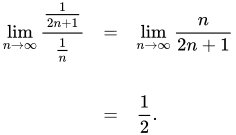
| Now, we have |
|
|
| Since this limit is a finite number greater than zero, we have |
| diverges by the |
| Limit Comparison Test. Therefore, we do not include |
| in our interval. |




| Step 6: |
|---|
| The interval of convergence is |
![{\displaystyle (2,4].}](https://wikimedia.org/api/rest_v1/media/math/render/svg/45ad0009cd49d7732f72f4bfe26f00c0671fecc8)
| Final Answer: |
|---|
| (a) The radius of convergence is and the interval of convergence is |
| (b) The radius of convergence is and the interval of convergence is |
