Difference between revisions of "009C Sample Final 1, Problem 5"
Kayla Murray (talk | contribs) |
Kayla Murray (talk | contribs) |
||
| Line 14: | Line 14: | ||
|'''1.''' '''Ratio Test''' | |'''1.''' '''Ratio Test''' | ||
|- | |- | ||
| − | | Let <math style="vertical-align: -7px">\sum a_n</math> be a series and <math>L=\lim_{n\rightarrow \infty}\bigg|\frac{a_{n+1}}{a_n}\bigg|.</math> Then, | + | | Let <math style="vertical-align: -7px">\sum a_n</math> be a series and <math>L=\lim_{n\rightarrow \infty}\bigg|\frac{a_{n+1}}{a_n}\bigg|.</math> Then, |
|- | |- | ||
| | | | ||
| − | If <math style="vertical-align: - | + | If <math style="vertical-align: -4px">L<1,</math> the series is absolutely convergent. |
|- | |- | ||
| | | | ||
| − | If <math style="vertical-align: - | + | If <math style="vertical-align: -4px">L>1,</math> the series is divergent. |
|- | |- | ||
| | | | ||
| − | If <math style="vertical-align: - | + | If <math style="vertical-align: -4px">L=1,</math> the test is inconclusive. |
|- | |- | ||
|'''2.''' After you find the radius of convergence, you need to check the endpoints of your interval | |'''2.''' After you find the radius of convergence, you need to check the endpoints of your interval | ||
|- | |- | ||
| | | | ||
| − | for convergence since the Ratio Test is inconclusive when <math style="vertical-align: -1px">L=1.</math> | + | for convergence since the Ratio Test is inconclusive when <math style="vertical-align: -1px">L=1.</math> |
|} | |} | ||
| Line 56: | Line 56: | ||
!Step 2: | !Step 2: | ||
|- | |- | ||
| − | |Thus, we have <math style="vertical-align: -5px">|x|<1</math> and the radius of convergence of this series is <math style="vertical-align: -1px">1.</math> | + | |Thus, we have <math style="vertical-align: -5px">|x|<1</math> and the radius of convergence of this series is <math style="vertical-align: -1px">1.</math> |
|} | |} | ||
| Line 64: | Line 64: | ||
!Step 1: | !Step 1: | ||
|- | |- | ||
| − | |From part (a), we know the series converges inside the interval <math style="vertical-align: -5px">(-1,1).</math> | + | |From part (a), we know the series converges inside the interval <math style="vertical-align: -5px">(-1,1).</math> |
|- | |- | ||
|Now, we need to check the endpoints of the interval for convergence. | |Now, we need to check the endpoints of the interval for convergence. | ||
| Line 72: | Line 72: | ||
!Step 2: | !Step 2: | ||
|- | |- | ||
| − | |For <math style="vertical-align: - | + | |For <math style="vertical-align: -4px">x=1,</math> the series becomes <math>\sum_{n=1}^{\infty}n,</math> which diverges by the Divergence Test. |
|} | |} | ||
| Line 78: | Line 78: | ||
!Step 3: | !Step 3: | ||
|- | |- | ||
| − | |For <math style="vertical-align: - | + | |For <math style="vertical-align: -4px">x=-1,</math> the series becomes <math>\sum_{n=1}^{\infty}(-1)^n n,</math> which diverges by the Divergence Test. |
|- | |- | ||
| − | |Thus, the interval of convergence is <math style="vertical-align: -5px">(-1,1).</math> | + | |Thus, the interval of convergence is <math style="vertical-align: -5px">(-1,1).</math> |
|} | |} | ||
| Line 88: | Line 88: | ||
!Step 1: | !Step 1: | ||
|- | |- | ||
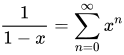
| − | |Recall that we have the geometric series formula <math>\frac{1}{1-x}=\sum_{n=0}^{\infty} x^n</math> for <math>|x|<1.</math> | + | |Recall that we have the geometric series formula <math>\frac{1}{1-x}=\sum_{n=0}^{\infty} x^n</math> for <math>|x|<1.</math> |
|- | |- | ||
|Now, we take the derivative of both sides of the last equation to get | |Now, we take the derivative of both sides of the last equation to get | ||
| Line 99: | Line 99: | ||
!Step 2: | !Step 2: | ||
|- | |- | ||
| − | |Now, we multiply the last equation in Step 1 by <math style="vertical-align: 0px">x.</math> | + | |Now, we multiply the last equation in Step 1 by <math style="vertical-align: 0px">x.</math> |
|- | |- | ||
|So, we have | |So, we have | ||
| Line 106: | Line 106: | ||
<math>\frac{x}{(1-x)^2}=\sum_{n=1}^{\infty}nx^{n}=f(x).</math> | <math>\frac{x}{(1-x)^2}=\sum_{n=1}^{\infty}nx^{n}=f(x).</math> | ||
|- | |- | ||
| − | |Thus, <math>f(x)=\frac{x}{(1-x)^2}.</math> | + | |Thus, <math>f(x)=\frac{x}{(1-x)^2}.</math> |
|} | |} | ||
Revision as of 16:15, 26 February 2017
Let

(a) Find the radius of convergence of the power series.
(b) Determine the interval of convergence of the power series.
(c) Obtain an explicit formula for the function Failed to parse (MathML with SVG or PNG fallback (recommended for modern browsers and accessibility tools): Invalid response ("Math extension cannot connect to Restbase.") from server "https://wikimedia.org/api/rest_v1/":): {\displaystyle f(x)} .
| Foundations: |
|---|
| 1. Ratio Test |
| Let Failed to parse (MathML with SVG or PNG fallback (recommended for modern browsers and accessibility tools): Invalid response ("Math extension cannot connect to Restbase.") from server "https://wikimedia.org/api/rest_v1/":): {\displaystyle \sum a_n} be a series and Failed to parse (MathML with SVG or PNG fallback (recommended for modern browsers and accessibility tools): Invalid response ("Math extension cannot connect to Restbase.") from server "https://wikimedia.org/api/rest_v1/":): {\displaystyle L=\lim_{n\rightarrow \infty}\bigg|\frac{a_{n+1}}{a_n}\bigg|.} Then, |
|
If Failed to parse (MathML with SVG or PNG fallback (recommended for modern browsers and accessibility tools): Invalid response ("Math extension cannot connect to Restbase.") from server "https://wikimedia.org/api/rest_v1/":): {\displaystyle L<1,} the series is absolutely convergent. |
|
If Failed to parse (MathML with SVG or PNG fallback (recommended for modern browsers and accessibility tools): Invalid response ("Math extension cannot connect to Restbase.") from server "https://wikimedia.org/api/rest_v1/":): {\displaystyle L>1,} the series is divergent. |
|
If Failed to parse (MathML with SVG or PNG fallback (recommended for modern browsers and accessibility tools): Invalid response ("Math extension cannot connect to Restbase.") from server "https://wikimedia.org/api/rest_v1/":): {\displaystyle L=1,} the test is inconclusive. |
| 2. After you find the radius of convergence, you need to check the endpoints of your interval |
|
for convergence since the Ratio Test is inconclusive when Failed to parse (MathML with SVG or PNG fallback (recommended for modern browsers and accessibility tools): Invalid response ("Math extension cannot connect to Restbase.") from server "https://wikimedia.org/api/rest_v1/":): {\displaystyle L=1.} |
Solution:
(a)
| Step 1: |
|---|
| To find the radius of convergence, we use the ratio test. We have |
|
Failed to parse (MathML with SVG or PNG fallback (recommended for modern browsers and accessibility tools): Invalid response ("Math extension cannot connect to Restbase.") from server "https://wikimedia.org/api/rest_v1/":): {\displaystyle \begin{array}{rcl} \displaystyle{\lim_{n \rightarrow \infty}\bigg|\frac{a_{n+1}}{a_n}\bigg|} & = & \displaystyle{\lim_{n \rightarrow \infty}\bigg|\frac{(n+1)x^{n+1}}{nx^n}}\bigg|\\ &&\\ & = & \displaystyle{\lim_{n \rightarrow \infty}\bigg|\frac{n+1}{n}x\bigg|}\\ &&\\ & = & \displaystyle{|x|\lim_{n \rightarrow \infty}\frac{n+1}{n}}\\ &&\\ & = & \displaystyle{|x|.}\\ \end{array}} |
| Step 2: |
|---|
| Thus, we have Failed to parse (MathML with SVG or PNG fallback (recommended for modern browsers and accessibility tools): Invalid response ("Math extension cannot connect to Restbase.") from server "https://wikimedia.org/api/rest_v1/":): {\displaystyle |x|<1} and the radius of convergence of this series is Failed to parse (MathML with SVG or PNG fallback (recommended for modern browsers and accessibility tools): Invalid response ("Math extension cannot connect to Restbase.") from server "https://wikimedia.org/api/rest_v1/":): {\displaystyle 1.} |
(b)
| Step 1: |
|---|
| From part (a), we know the series converges inside the interval Failed to parse (MathML with SVG or PNG fallback (recommended for modern browsers and accessibility tools): Invalid response ("Math extension cannot connect to Restbase.") from server "https://wikimedia.org/api/rest_v1/":): {\displaystyle (-1,1).} |
| Now, we need to check the endpoints of the interval for convergence. |
| Step 2: |
|---|
| For Failed to parse (MathML with SVG or PNG fallback (recommended for modern browsers and accessibility tools): Invalid response ("Math extension cannot connect to Restbase.") from server "https://wikimedia.org/api/rest_v1/":): {\displaystyle x=1,} the series becomes Failed to parse (MathML with SVG or PNG fallback (recommended for modern browsers and accessibility tools): Invalid response ("Math extension cannot connect to Restbase.") from server "https://wikimedia.org/api/rest_v1/":): {\displaystyle \sum_{n=1}^{\infty}n,} which diverges by the Divergence Test. |
| Step 3: |
|---|
| For Failed to parse (MathML with SVG or PNG fallback (recommended for modern browsers and accessibility tools): Invalid response ("Math extension cannot connect to Restbase.") from server "https://wikimedia.org/api/rest_v1/":): {\displaystyle x=-1,} the series becomes Failed to parse (MathML with SVG or PNG fallback (recommended for modern browsers and accessibility tools): Invalid response ("Math extension cannot connect to Restbase.") from server "https://wikimedia.org/api/rest_v1/":): {\displaystyle \sum_{n=1}^{\infty}(-1)^n n,} which diverges by the Divergence Test. |
| Thus, the interval of convergence is Failed to parse (MathML with SVG or PNG fallback (recommended for modern browsers and accessibility tools): Invalid response ("Math extension cannot connect to Restbase.") from server "https://wikimedia.org/api/rest_v1/":): {\displaystyle (-1,1).} |
(c)
| Step 1: |
|---|
| Recall that we have the geometric series formula for Failed to parse (MathML with SVG or PNG fallback (recommended for modern browsers and accessibility tools): Invalid response ("Math extension cannot connect to Restbase.") from server "https://wikimedia.org/api/rest_v1/":): {\displaystyle |x|<1.} |
| Now, we take the derivative of both sides of the last equation to get |
|
Failed to parse (MathML with SVG or PNG fallback (recommended for modern browsers and accessibility tools): Invalid response ("Math extension cannot connect to Restbase.") from server "https://wikimedia.org/api/rest_v1/":): {\displaystyle \frac{1}{(1-x)^2}=\sum_{n=1}^{\infty}nx^{n-1}.} |
| Step 2: |
|---|
| Now, we multiply the last equation in Step 1 by Failed to parse (MathML with SVG or PNG fallback (recommended for modern browsers and accessibility tools): Invalid response ("Math extension cannot connect to Restbase.") from server "https://wikimedia.org/api/rest_v1/":): {\displaystyle x.} |
| So, we have |
|
Failed to parse (MathML with SVG or PNG fallback (recommended for modern browsers and accessibility tools): Invalid response ("Math extension cannot connect to Restbase.") from server "https://wikimedia.org/api/rest_v1/":): {\displaystyle \frac{x}{(1-x)^2}=\sum_{n=1}^{\infty}nx^{n}=f(x).} |
| Thus, Failed to parse (MathML with SVG or PNG fallback (recommended for modern browsers and accessibility tools): Invalid response ("Math extension cannot connect to Restbase.") from server "https://wikimedia.org/api/rest_v1/":): {\displaystyle f(x)=\frac{x}{(1-x)^2}.} |
| Final Answer: |
|---|
| (a) Failed to parse (MathML with SVG or PNG fallback (recommended for modern browsers and accessibility tools): Invalid response ("Math extension cannot connect to Restbase.") from server "https://wikimedia.org/api/rest_v1/":): {\displaystyle 1} |
| (b) Failed to parse (MathML with SVG or PNG fallback (recommended for modern browsers and accessibility tools): Invalid response ("Math extension cannot connect to Restbase.") from server "https://wikimedia.org/api/rest_v1/":): {\displaystyle (-1,1)} |
| (c) Failed to parse (MathML with SVG or PNG fallback (recommended for modern browsers and accessibility tools): Invalid response ("Math extension cannot connect to Restbase.") from server "https://wikimedia.org/api/rest_v1/":): {\displaystyle f(x)=\frac{x}{(1-x)^2}} |