Difference between revisions of "009A Sample Midterm 2, Problem 1"
Jump to navigation
Jump to search
Kayla Murray (talk | contribs) |
Kayla Murray (talk | contribs) |
||
| Line 21: | Line 21: | ||
!Step 1: | !Step 1: | ||
|- | |- | ||
| − | ||We begin by noticing that we plug in <math>x=2</math> into | + | ||We begin by noticing that we plug in <math style="vertical-align: 0px">x=2</math> into |
|- | |- | ||
| <math>\frac{\sqrt{x^2+12}-4}{x-2},</math> | | <math>\frac{\sqrt{x^2+12}-4}{x-2},</math> | ||
|- | |- | ||
| − | |we get <math>\frac{0}{0}.</math> | + | |we get <math style="vertical-align: -12px">\frac{0}{0}.</math> |
|} | |} | ||
| Line 88: | Line 88: | ||
!Step 1: | !Step 1: | ||
|- | |- | ||
| − | |We begin by looking at the graph of <math>y=\tan(x),</math> | + | |We begin by looking at the graph of <math style="vertical-align: -5px">y=\tan(x),</math> |
|- | |- | ||
|which is displayed below. | |which is displayed below. | ||
| Line 98: | Line 98: | ||
!Step 2: | !Step 2: | ||
|- | |- | ||
| − | |We are taking a left hand limit. So, we approach <math>x=\frac{\pi}{2}</math> from the left. | + | |We are taking a left hand limit. So, we approach <math style="vertical-align: -13px">x=\frac{\pi}{2}</math> from the left. |
|- | |- | ||
| − | |If we look at the graph from the left of <math>x=\frac{\pi}{2}</math> and go towards <math>\frac{\pi}{2},</math> | + | |If we look at the graph from the left of <math style="vertical-align: -13px">x=\frac{\pi}{2}</math> and go towards <math style="vertical-align: -13px">\frac{\pi}{2},</math> |
|- | |- | ||
| − | |we see that <math>\tan(x)</math> goes to <math>+\infty.</math> | + | |we see that <math style="vertical-align: -5px">\tan(x)</math> goes to <math style="vertical-align: -2px">+\infty.</math> |
|- | |- | ||
|Therefore, | |Therefore, | ||
Revision as of 15:06, 18 February 2017
Evaluate the following limits.
(a) Find

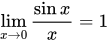
(b) Find

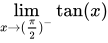
(c) Evaluate
| Foundations: |
|---|
Solution:
(a)
| Step 1: |
|---|
| We begin by noticing that we plug in into |
| we get |


| Step 2: |
|---|
| Now, we multiply the numerator and denominator by the conjugate of the numerator. |
| Hence, we have |

(b)
| Step 1: |
|---|
| First, we write |

| Step 2: |
|---|
| Now, we have |
|
|

(c)
| Step 1: |
|---|
| We begin by looking at the graph of |
| which is displayed below. |
| (Insert graph) |

| Step 2: |
|---|
| We are taking a left hand limit. So, we approach from the left. |
| If we look at the graph from the left of and go towards |
| we see that goes to |
| Therefore, |


| Final Answer: |
|---|
| (a) |
| (b) |
| (c) |


