|
|
| Line 1: |
Line 1: |
| | <span class="exam">Find the following limits: | | <span class="exam">Find the following limits: |
| | | | |
| − | <span class="exam">a) If <math>\lim _{x\rightarrow 3} \bigg(\frac{f(x)}{2x}+1\bigg)=2,</math> find <math>\lim _{x\rightarrow 3} f(x).</math> | + | <span class="exam">(a) If <math>\lim _{x\rightarrow 3} \bigg(\frac{f(x)}{2x}+1\bigg)=2,</math> find <math>\lim _{x\rightarrow 3} f(x).</math> |
| | | | |
| − | <span class="exam">b) Find <math>\lim _{x\rightarrow 0} \frac{\tan(4x)}{\sin(6x)}. </math> | + | <span class="exam">(b) Find <math>\lim _{x\rightarrow 0} \frac{\tan(4x)}{\sin(6x)}. </math> |
| | | | |
| − | <span class="exam">c) Evaluate <math>\lim _{x\rightarrow \infty} \frac{-2x^3-2x+3}{3x^3+3x^2-3}. </math> | + | <span class="exam">(c) Evaluate <math>\lim _{x\rightarrow \infty} \frac{-2x^3-2x+3}{3x^3+3x^2-3}. </math> |
| | | | |
| | | | |
Revision as of 13:37, 18 February 2017
Find the following limits:
(a) If 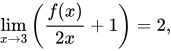 find
find 
(b) Find 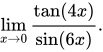
(c) Evaluate 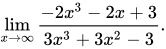
| Foundations:
|
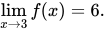
1. If  , we have , we have
|
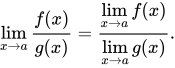
|
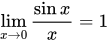
2. 
|
Solution:
(a)
| Step 1:
|
| First, we have
|
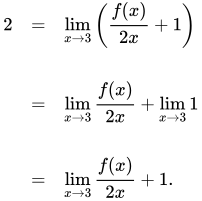
|
| Therefore,
|
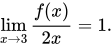
|
(b)
| Step 1:
|
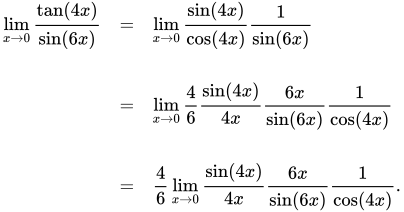
| First, we write
|
|
| Step 2:
|
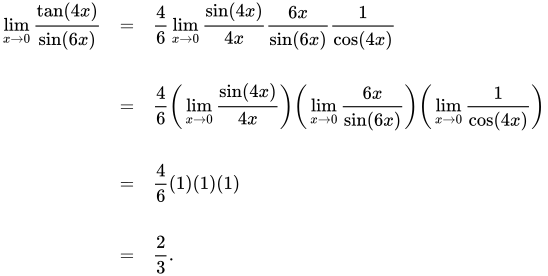
| Now, we have
|
|
|
(c)
| Step 1:
|
| First, we have
|

|
| Step 2:
|
| Now, we use the properties of limits to get
|
|

|
| Final Answer:
|
(a) 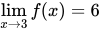
|
(b) 
|
(c) 
|
Return to Sample Exam