Difference between revisions of "009B Sample Midterm 1, Problem 5"
Jump to navigation
Jump to search
Kayla Murray (talk | contribs) |
Kayla Murray (talk | contribs) |
||
| Line 8: | Line 8: | ||
{| class="mw-collapsible mw-collapsed" style = "text-align:left;" | {| class="mw-collapsible mw-collapsed" style = "text-align:left;" | ||
!Foundations: | !Foundations: | ||
| − | |||
| − | |||
|- | |- | ||
|'''1.''' The height of each rectangle in the left-hand Riemann sum is given by choosing the left endpoint of the interval. | |'''1.''' The height of each rectangle in the left-hand Riemann sum is given by choosing the left endpoint of the interval. | ||
Revision as of 08:21, 7 February 2017
Let .
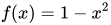
- a) Compute the left-hand Riemann sum approximation of with boxes.
- b) Compute the right-hand Riemann sum approximation of with boxes.
- c) Express as a limit of right-hand Riemann sums (as in the definition of the definite integral). Do not evaluate the limit.


| Foundations: |
|---|
| 1. The height of each rectangle in the left-hand Riemann sum is given by choosing the left endpoint of the interval. |
| 2. The height of each rectangle in the right-hand Riemann sum is given by choosing the right endpoint of the interval. |
| 3. See the Riemann sums (insert link) for more information. |
Solution:
(a)
| Step 1: |
|---|
| Since our interval is and we are using 3 rectangles, each rectangle has width 1. So, the left-hand Riemann sum is |
![{\displaystyle [0,3]}](https://wikimedia.org/api/rest_v1/media/math/render/svg/d5c9e70f7d437509d4ebedb0eaf7ada946e91a79)

| Step 2: |
|---|
| Thus, the left-hand Riemann sum is |

(b)
| Step 1: |
|---|
| Since our interval is and we are using 3 rectangles, each rectangle has width 1. So, the right-hand Riemann sum is |

| Step 2: |
|---|
| Thus, the right-hand Riemann sum is |

(c)
| Step 1: |
|---|
| Let be the number of rectangles used in the right-hand Riemann sum for |
| The width of each rectangle is |

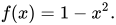

| Step 2: |
|---|
| So, the right-hand Riemann sum is |
| Finally, we let go to infinity to get a limit. |
| Thus, is equal to |


| Final Answer: |
|---|
| (a) |
| (b) |
| (c) |


