Difference between revisions of "009C Sample Midterm 2"
Jump to navigation
Jump to search
Kayla Murray (talk | contribs) (→ Problem 4 ) |
Kayla Murray (talk | contribs) (→ Problem 5 ) |
||
| Line 26: | Line 26: | ||
== [[009C_Sample Midterm 2,_Problem_5|<span class="biglink"><span style="font-size:80%"> Problem 5 </span>]] == | == [[009C_Sample Midterm 2,_Problem_5|<span class="biglink"><span style="font-size:80%"> Problem 5 </span>]] == | ||
| − | <span class="exam"> | + | <span class="exam"> If <math>\sum_{n=0}^\infty c_nx^n</math> converges, does it follow that the following series converges? |
| − | + | ::<span class="exam">a) <math>\sum_{n=0}^\infty c_n\bigg(\frac{x}{2}\bigg)^n</math> | |
| − | + | ::<span class="exam">b) <math>\sum_{n=0}^\infty c_n(-x)^n </math> | |
| − | <span class="exam"> | ||
Revision as of 18:23, 4 February 2017
This is a sample, and is meant to represent the material usually covered in Math 9C for the midterm. An actual test may or may not be similar. Click on the boxed problem numbers to go to a solution.
Problem 1
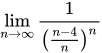
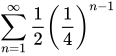
Evaluate:
- a)
- b)
Problem 2
Determine convergence or divergence:

Problem 3
Determine convergence or divergence:
- a) Failed to parse (MathML with SVG or PNG fallback (recommended for modern browsers and accessibility tools): Invalid response ("Math extension cannot connect to Restbase.") from server "https://wikimedia.org/api/rest_v1/":): {\displaystyle \sum_{n=1}^\infty (-1)^n \sqrt{\frac{1}{n}}}
- b) Failed to parse (MathML with SVG or PNG fallback (recommended for modern browsers and accessibility tools): Invalid response ("Math extension cannot connect to Restbase.") from server "https://wikimedia.org/api/rest_v1/":): {\displaystyle \sum_{n=1}^\infty (-2)^n \frac{n!}{n^n} }
Problem 4
Find the radius of convergence and interval of convergence of the series.
- a) Failed to parse (MathML with SVG or PNG fallback (recommended for modern browsers and accessibility tools): Invalid response ("Math extension cannot connect to Restbase.") from server "https://wikimedia.org/api/rest_v1/":): {\displaystyle \sum_{n=0}^\infty n^nx^n}
- b) Failed to parse (MathML with SVG or PNG fallback (recommended for modern browsers and accessibility tools): Invalid response ("Math extension cannot connect to Restbase.") from server "https://wikimedia.org/api/rest_v1/":): {\displaystyle \sum_{n=0}^\infty \frac{(x+1)^n}{\sqrt{n}}}
Problem 5
If Failed to parse (MathML with SVG or PNG fallback (recommended for modern browsers and accessibility tools): Invalid response ("Math extension cannot connect to Restbase.") from server "https://wikimedia.org/api/rest_v1/":): {\displaystyle \sum_{n=0}^\infty c_nx^n} converges, does it follow that the following series converges?
- a) Failed to parse (MathML with SVG or PNG fallback (recommended for modern browsers and accessibility tools): Invalid response ("Math extension cannot connect to Restbase.") from server "https://wikimedia.org/api/rest_v1/":): {\displaystyle \sum_{n=0}^\infty c_n\bigg(\frac{x}{2}\bigg)^n}
- b) Failed to parse (MathML with SVG or PNG fallback (recommended for modern browsers and accessibility tools): Invalid response ("Math extension cannot connect to Restbase.") from server "https://wikimedia.org/api/rest_v1/":): {\displaystyle \sum_{n=0}^\infty c_n(-x)^n }