Difference between revisions of "009B Sample Final 1, Problem 1"
Jump to navigation
Jump to search
Kayla Murray (talk | contribs) |
(→Temp1) |
||
| Line 30: | Line 30: | ||
|We need to set these two equations equal in order to find the intersection points of these functions. | |We need to set these two equations equal in order to find the intersection points of these functions. | ||
|- | |- | ||
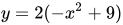
| − | |So, we let <math style="vertical-align: - | + | |So, we let <math style="vertical-align: -5px">2(-x^2+9)=0</math>. Solving for <math style="vertical-align: 0px">x</math>, we get <math style="vertical-align: 0px">x=\pm 3</math>. |
|- | |- | ||
| − | |This means that we need to calculate the Riemann sums over the interval <math>[-3,3]</math>. | + | |This means that we need to calculate the Riemann sums over the interval <math style="vertical-align: -5px">[-3,3]</math>. |
|- | |- | ||
| | | | ||
| Line 40: | Line 40: | ||
!Step 2: | !Step 2: | ||
|- | |- | ||
| − | |Since the length of our interval is <math style="vertical-align: 0px">6</math> and we are using <math style="vertical-align: | + | |Since the length of our interval is <math style="vertical-align: 0px">6</math> and we are using <math style="vertical-align: -1px">3</math> rectangles, |
|- | |- | ||
| − | |each rectangle will have width <math style="vertical-align: 0px">2</math>. | + | |each rectangle will have width <math style="vertical-align: 0px">2</math> . |
|- | |- | ||
|Thus, the lower Riemann sum is | |Thus, the lower Riemann sum is | ||
|- | |- | ||
| | | | ||
| − | ::<math>2(f(-3)+f(-1)+f(3))=2(0+16+0)=32</math> | + | ::<math>2(f(-3)+f(-1)+f(3))\,=\,2(0+16+0)\,=\,32.</math> |
|} | |} | ||
Revision as of 12:26, 25 February 2016
Consider the region bounded by the following two functions:
- and .

a) Using the lower sum with three rectangles having equal width, approximate the area.
b) Using the upper sum with three rectangles having equal width, approximate the area.
c) Find the actual area of the region.
| Foundations: |
|---|
| Recall: |
| 1. The height of each rectangle in the lower Riemann sum is given by choosing the minimum value of the left and right endpoints of the rectangle. |
| 2. The height of each rectangle in the upper Riemann sum is given by choosing the maximum value of the left and right endpoints of the rectangle. |
| 3. The area of the region is given by for appropriate values . |


Solution:
(a)
Temp1
| Step 1: |
|---|
| We need to set these two equations equal in order to find the intersection points of these functions. |
| So, we let . Solving for , we get . |
| This means that we need to calculate the Riemann sums over the interval . |


![{\displaystyle [-3,3]}](https://wikimedia.org/api/rest_v1/media/math/render/svg/3a869f6f7ff84a95f888c6b8705e2465ba21960e)
| Step 2: |
|---|
| Since the length of our interval is and we are using rectangles, |
| each rectangle will have width . |
| Thus, the lower Riemann sum is |
|
|


(b)
Temp2
| Step 1: |
|---|
| As in Part (a), the length of our inteval is and |
| each rectangle will have width . (See Step 1 and 2 for (a)) |
| Step 2: |
|---|
| Thus, the upper Riemann sum is |
|
|

(c)
Temp3
| Step 1: |
|---|
| To find the actual area of the region, we need to calculate |
|
|

| Step 2: |
|---|
| We integrate to get |
|
|

Temp4
| Final Answer: |
|---|
| (a) |
| (b) |
| (c) |


