|
|
| Line 1: |
Line 1: |
| | <span class="exam">In each part, compute the limit. If the limit is infinite, be sure to specify positive or negative infinity. | | <span class="exam">In each part, compute the limit. If the limit is infinite, be sure to specify positive or negative infinity. |
| | | | |
| − | ::<span class="exam">a) <math>\lim_{x\rightarrow -3} \frac{x^3-9x}{6+2x}</math>
| + | <span class="exam">a) <math>\lim_{x\rightarrow -3} \frac{x^3-9x}{6+2x}</math> |
| − | ::<span class="exam">b) <math>\lim_{x\rightarrow 0^+} \frac{\sin (2x)}{x^2}</math>
| + | |
| − | ::<span class="exam">c) <math>\lim_{x\rightarrow -\infty} \frac{3x}{\sqrt{4x^2+x+5}}</math>
| + | <span class="exam">b) <math>\lim_{x\rightarrow 0^+} \frac{\sin (2x)}{x^2}</math> |
| | + | |
| | + | <span class="exam">c) <math>\lim_{x\rightarrow -\infty} \frac{3x}{\sqrt{4x^2+x+5}}</math> |
| | | | |
| | {| class="mw-collapsible mw-collapsed" style = "text-align:left;" | | {| class="mw-collapsible mw-collapsed" style = "text-align:left;" |
Revision as of 21:46, 1 February 2016
In each part, compute the limit. If the limit is infinite, be sure to specify positive or negative infinity.
a) 
b) 
c) 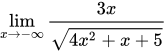
Solution:
(a)
(b)
(c)
| Final Answer:
|
| (a)
|
| (b)
|
| (c)
|
Return to Sample Exam